Class 10 (SEE) Math Important Questions – 2082 | NEB Education
Class 10 (SEE) Math Important Questions are specially designed practice questions based on the latest NEB syllabus. These questions help students understand exam patterns, improve problem-solving skills, and score better marks in the SEE examination.
Here you will find important question sets, model questions, and exam-focused practice exercises for SEE 2082. Practice all the questions given below to strengthen your preparation.
Class 10 (SEE) Math Important Questions
Question No.1: Sets
In an examination, 80 students passed in Mathematics, 70 failed in Mathematics, 90 failed in Science and 20 failed in both.
Illustrate the given information in a Venn diagram.
How many students passed in Science?
How many students passed in both subjects?
How many students passed in both Mathematics and Science?
75 students in a class like Cristiano Ronaldo or Lionel Messi or both. Out of them, 10 like both players. The ratio of the number of students who like Cristiano Ronaldo to those who like Lionel Messi is 2:3.
Find the number of students who like Cristiano Ronaldo.
Find the number of students who like only Lionel Messi.
Represent the result in a Venn diagram.
A survey conducted among students showed that:
50 like singing
40 like dancing
35 like acting
20 like both singing and dancing
12 like both dancing and acting
18 like both acting and singing
7 like all three activities
Every student likes at least one activity.
How many students were surveyed?
How many students like only dancing?
How many students like only acting?
How many students like only one activity?
There are 400 students in a school. They are allowed to vote for Ajay or Ojaswi as school prefect.
50 students voted for both
24 did not vote
Ojaswi won by 56 more votes than Ajay
How many students cast their votes?
How many valid votes did Ajay receive?
How many valid votes were there?
Represent the result in a Venn diagram.
In a group of students:
20 study Economics
18 study History
21 study Science
7 study Economics only
10 study Science only
6 study Economics and Science only
3 study Science and History only
Represent the information in a Venn diagram.
How many students study all subjects?
How many students are there in total?
Question No.2: Arithmetic
Minakshi invested Rs. 85,000 for 1 year in Goodwill Finance at the rate of 8% per annum.
How much interest will she receive if it is compounded each year?
How much interest will she receive if it is compounded every 6 months?
How much interest will she receive if it is compounded every 3 months?
Mr. Bantawa borrowed a sum of Rs. 1,00,000 from Agricultural Development Bank for 3 years to upgrade his poultry farming. The bank charged 5% interest compounded annually for the first year, and the rate of interest was gradually increased by 1% every year.
How much interest did he pay at the end of the third year?
The compound interest of a sum of money at 8% per annum for 2 years is more than the simple interest on the same sum at the same rate for the same time by Rs. 76.80. Find:
The sum
The interest compounded annually
A man borrowed Rs. 1,00,000 from a bank. If he paid a compound interest of Rs. 33,100 at the end of 3 years, find the rate of interest compounded annually charged by the bank.
If a sum becomes Rs. 6,655 in 3 years and Rs. 7,320.50 in 4 years, interest being compounded annually, find:
The rate of interest
The sum
Gita borrowed Rs. 85,000 from a bank at the rate of 12% per annum compounded semi-annually for 2 years. After one year, the bank changed its policy to charge interest compounded quarterly at the same rate.
How much interest did she pay in the first year?
How much interest did she pay in the second year?
How much less interest would she pay if the bank had not changed the policy?
Question No.3:
After depreciation at the rate of 15% per annum, the value of a vehicle became Rs. 13,26,000 after one year. Find the original value of the vehicle.
The value of a machine depreciates every year by 10%. What will be the value of a machine worth Rs. 1,80,000 after 3 years?
A mobile costing Rs. 6,000 is depreciated per year, and after 2 years its price becomes Rs. 5,415. Find the rate of depreciation.
Mr. Chhetri bought a scanner machine 3 years before for Rs. 40,000. If the value of the machine depreciates by 5%, 8%, and 10% in the first, second, and third year respectively, at what price did he sell the machine at the end of 3 years?
At the annual rate of compound depreciation, if the value of a computer becomes Rs. 40,500 in 2 years and Rs. 36,450 in 3 years, find:
The rate of depreciation
The original cost
Three years ago, the population of a village was 16,000. The population growth rate of that village is 5%. What is the population at present?
In how many years will the population of a town be 2,09,475 from 1,90,000 at a growth rate of 5% per annum?
The population of a village increases every year by 5%. At the end of two years, if 460 people migrated to other villages and the population remained 26,000, what was the population at the beginning?
After two years, the population of a town will be 33,620 at a growth rate of 2.5% per annum. Find the present population of the town.
The population of a village increased from 10,000 to 11,000 in one year. Find the rate of growth of the population.
Question No.4:
The buying and selling rates of 1 Canadian Dollar in Annapurna Money Exchange Centre are NRs. 95.96 and NRs. 96.40 respectively. How many Canadian dollars should it buy and sell to make a profit of NRs. 4,400?
If the exchange rate of £1 is Rs. 147.00 and the exchange rate of US$1 is Rs. 113.00, how many dollars can be exchanged for 100 sterling pounds?
Mrs. Magar wants to buy a book online. She finds a publisher in London selling the book for £15 with free delivery. She also finds the same book from a publisher in New York for $17 with a transportation fee of $2. Which publisher should she buy the book from?
Mr. Gurung bought 10 tola gold in Hong Kong for HKD $3,900 per tola at the rate of HKD $1 = NPR 16.88.
Find the total cost of gold in NPR.
Find the final cost if 25% customs duty was charged.
Additional Question
A businessman arrived in Nepal from Kuwait with some Kuwaiti Dinars and immediately booked a ticket for China. He exchanged 111,000 Kuwaiti Dinars for Chinese Yuan.
(Given: 1 KWD = NPR 420 and 1 CNY = NPR 18.50)
How many Chinese Yuan did he exchange?
If the Nepali rupee had been devalued by 2.5% relative to the Dinar and the exchange rate of the Chinese Yuan remained unchanged, how many Yuan would he have received?
Question No.5: Mensuration
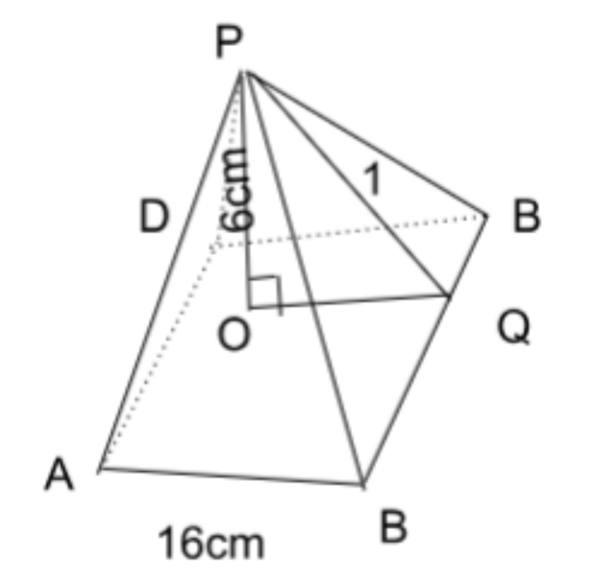
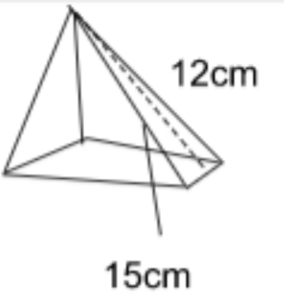
The length of the side of a square-based pyramid is 16 cm and its lateral surface area is 448 cm2. Find the length of its slant height.
From the following square-based pyramids, find the length of slant height (l).
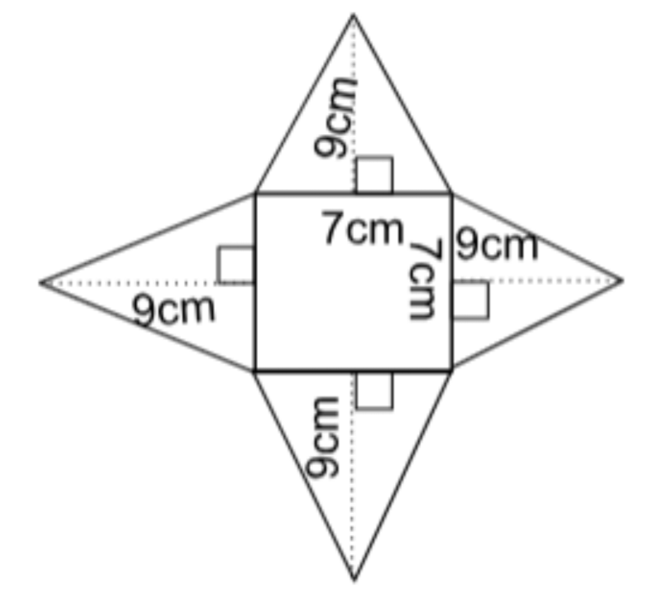
The nets of square-based pyramids are given below. Find:
The area of triangular faces (Lateral Surface Area)
The total surface area of the pyramids
40 tourists came to visit Mt. Annapurna from Canada. They planned to stay at Annapurna Base Camp for 4 days. For this purpose, they ordered some square-based pyramid tents in Nepal. A tent can hold 8 people and each person has 6 ft × 3 ft space on the ground with 48 cu. ft of air to breathe.
Find the length of the side of the base of each tent.
Find the total cost of all tents at the rate of Rs. 450 per sq. ft.
The diameter of the circular base of a right cone is 10 cm and its total surface area is 90π cm2. Find its:
Slant height
Vertical height
Volume
Question No.6:
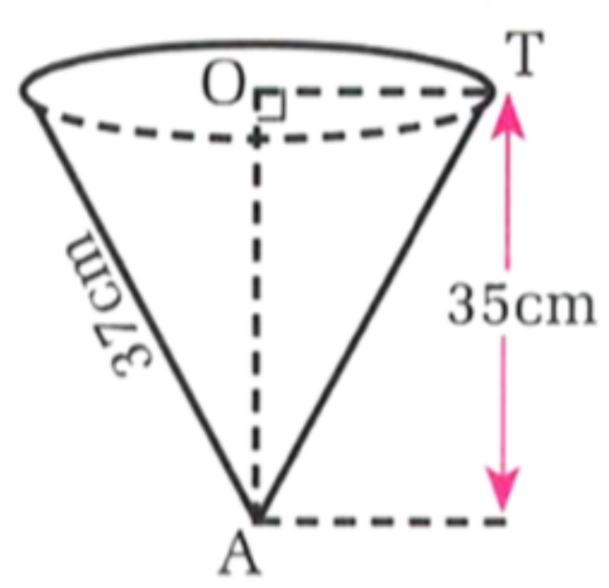
Find the volume of the following right circular cones:
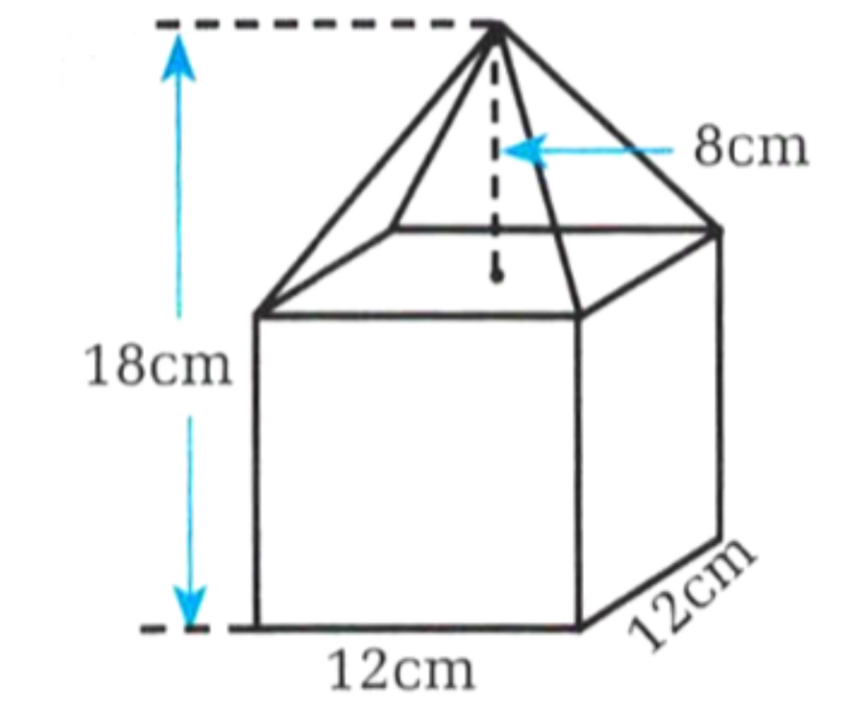
The following combined solid is made up of a pyramid and a prism (cuboid) having a common base. Find:
The lateral surface area of the uppermost pyramid
The lateral surface area of the lowermost prism (cuboid)
The total surface area of the given combined solid
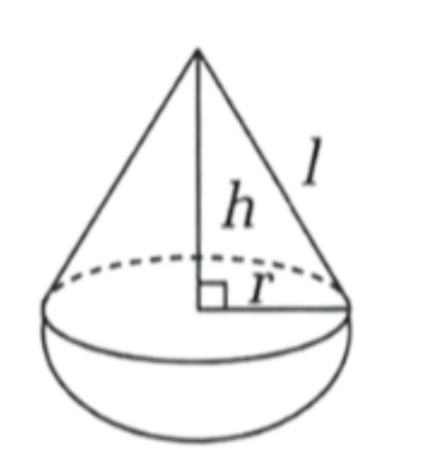
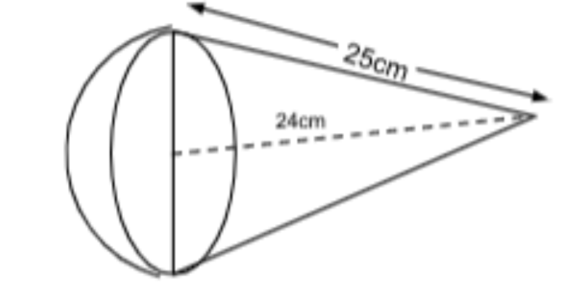
In the given combined solid, a right cone is placed on a hemisphere of equal radii. Write the formula to find:
Curved surface area (C.S.A) of the hemispherical portion
Curved surface area (C.S.A) of the conical portion
The surface area of the combined solid
Volume of the conical portion
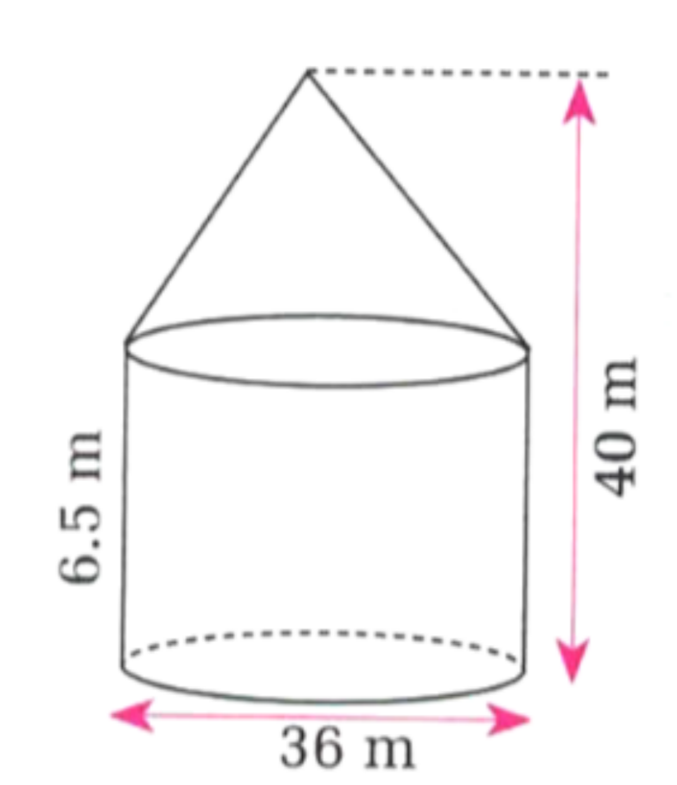
A tent is cylindrical up to a height of 9 ft and conical above it. The diameter of the base is 16 ft and the total height of the tent is 24 ft.
What is the height of the conical part?
What is the slant height of the conical part?
How much canvas is required to make the tent?
Question No.7:
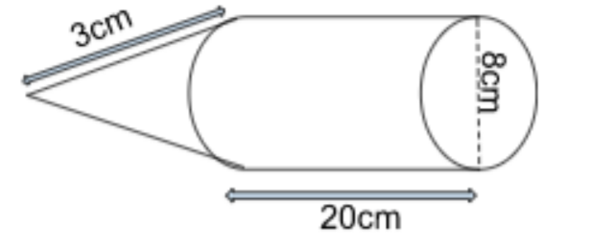
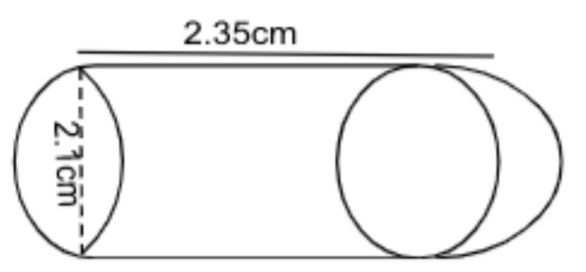
Find the cost of a pencil-shaped solid object at the rate of Rs. 10 per sq. unit.
Find the Volume, Total Surface Area (T.S.A), and Curved Surface Area (C.S.A) of the given figure:
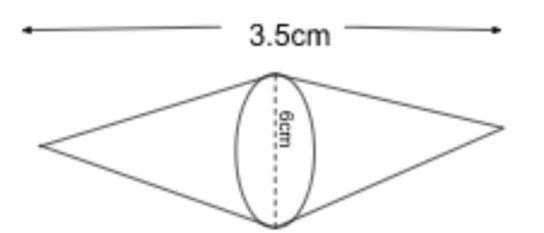
Find the Total Surface Area (T.S.A) and Volume of the given solid:
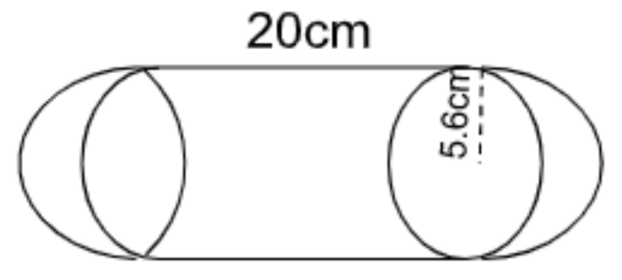
Find the total cost of painting the solid object at the rate of Rs. 20 per sq. unit.
Find the volume of the given figure:
Find the Total Surface Area (T.S.A) and Volume of the given solid:
Question No.8: Algebra
What is the arithmetic mean between 5 and 7?
Find the 2nd term of the following arithmetic sequence: 1st term = -5 and 3rd term = -55.
There are n arithmetic means between 7 and 27. If the second mean is 15, find:
The common difference
The value of n
The remaining means
In an A.P., a few arithmetic means are inserted between 75 and 105. If the ratio of the first mean to the last mean is 4:5, find:
The common difference
The number of means
The means
The population of a municipality increased by 500 in the year B.S. 2079. The rate of population growth is expected to decrease by a fixed number every year so that there will be an increase of only 400 people in B.S. 2084. Find:
The expected decrease rate in population growth per year
The increased number of population in each year from B.S. 2080 to B.S. 2083
Find the sum of the following series: 2 + 4 + 6 + ... up to 40 terms.
If the sum of the first 55 terms of an A.P. is 6600, find the 28th term.
The fifth term and the twelfth term of an arithmetic progression are 30 and 65 respectively. Find:
The first term and common difference
The sum of the first 26 terms
The sum of the first seven terms of an A.P. is 14 and the sum of the first ten terms is 125. Find:
The first term and common difference
The sum of the first 25 terms
Identify the second mean in the geometric sequence: 1, 3, 9, 27, 81, ?
If 8, x, y, 27 are in G.P., find:
The common ratio
The values of x and y
There are n geometric means between 1 and 64. If the ratio of the first mean to the last mean is 1:16, find:
The common ratio
The value of n
The means
The first term of a geometric series is 4 and the common ratio is 2. Find the sum of its first 8 terms.
In a G.P., the second term is 48 and the fifth term is 6. Find:
The first term and common ratio
The fourth term
The sum of the first 6 terms
A man borrows Rs. 18,900 without interest and repays the loan in 6 installments, each installment being double the preceding one. Find:
The first installment
The last installment
Question No.9:
If 8 is subtracted from thrice the square of a natural number, the difference is 40. Find the number.
If the sum of a number and 21 times its reciprocal is 10, find the number.
A number exceeds another number by 3 and their product is 40. Find the numbers.
The present ages of two brothers are 15 years and 22 years respectively. After how many years will the product of their ages be 408?
One year hence, a father's age will be 5 times the age of his son. The product of their present ages is 145. Find their present ages.
Question No.9 Extra:
Question No.10:
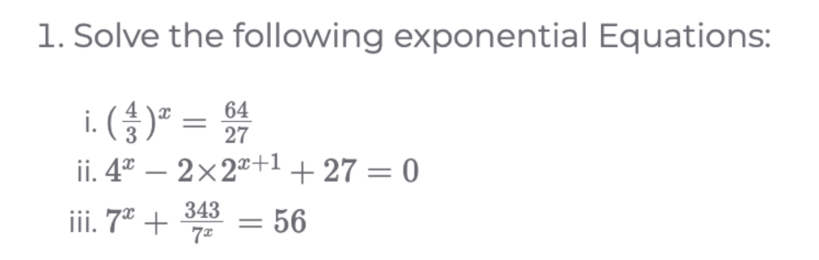
Refer to the given question from the image:
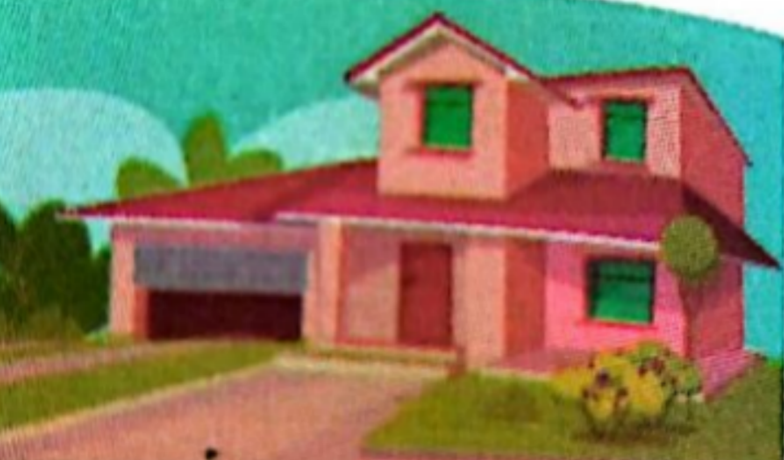
Mr. Kamal bought a plot of 5 Aana land in a municipality. He built a house covering some Aana and the remaining land is used as a kitchen garden.
Refer to the figure below:
Make the exponential equation.
Solve the equation for x.
Find the area of the kitchen garden.
Find the area of the plot occupied by the house.
If the given relations hold, prove that the required result is true:
(Use the expressions provided in the question to prove the identity.)
If the given conditions are satisfied, prove that:
pqr = p + q + r + 2
Question No.11: Geometry
Construct a parallelogram MINA in which:
MI = 6 cm
IU = 4.5 cm
∠AMI = (given angle)
Then construct a triangle MUD equal in area to the parallelogram MINA, having a side UD = 7.5 cm.
Construct a quadrilateral ABCD having:
AB = 6 cm
BC = 5.5 cm
AC = 6.5 cm
CD = 8 cm
AD = 7 cm
Then construct a triangle ABE equal in area to the quadrilateral ABCD.
Construct a triangle ABC in which:
a = 7.8 cm
b = 7.2 cm
c = 6.3 cm
Then construct a parallelogram DBEF equal in area to ΔABC, with ∠DBC = (given angle).
Construct a parallelogram PQRS in which:
PQ = 5 cm
Diagonal PR = 6 cm
Diagonal QS = 8 cm
Then construct a triangle PSA whose area is equal to the area of the parallelogram.
Question No.12:
Construct a triangle XYZ in which:
XY = 6.3 cm
∠X = (given angle)
∠Y = (given angle)
Then construct another triangle WXY equal in area to ΔXYZ with side WY = 7.5 cm.
Construct a quadrilateral PQRS having:
PQ = QR = 5.9 cm
RS = PS = 6.1 cm
∠QPS = (given angle)
Then construct a triangle PST equal in area to the quadrilateral PQRS.
Construct a quadrilateral ABCD in which:
AB = 5.4 cm
BC = 5.1 cm
CD = 4.9 cm
AD = 6.1 cm
Diagonal BD = 5.7 cm
Also, construct a triangle equal in area to the quadrilateral ABCD.
Construct a triangle having a given angle and whose area equals the area of a rectangle of length 6 cm and breadth 4.5 cm.
Question No.13:
Construct a triangle MNQ equal in area to the quadrilateral MNOP having:
NO = OP = 5.5 cm
PM = MN = 4.5 cm
∠MNO = (given angle)
Construct a triangle having a given angle and whose area is equal to the area of a parallelogram ABCD having:
Base side = 6 cm
Diagonal = 7 cm
Angle made by diagonal with the base side = (given angle)
In the given figure, O is the center of the circle. If ∠AOB = 95°, find:
The degree measure of arc AB
The degree measure of arc ACB
Question No.14: Statictics & Probability
The mean of the given data is 28. Find the value of k.
Class Interval
0-10
10-20
20-30
30-40
40-50
50-60
Frequency (f)
12
18
27
k
17
6
The following marks are obtained by students in mathematics:
According to the given data, find the maximum marks obtained by below 75% of students.
C.I.
0-5
5-10
10-15
15-20
20-25
Frequency (f)
6
4
7
5
8
If the first quartile of the data is 30.625, find the value of a.
C.I.
20-30
30-40
40-50
50-60
60-70
Frequency (f)
8
a
5
4
3
Find:
Class
Less than 12
Less than 24
Less than 36
Less than 48
Less than 60
Frequency (f)
3
9
19
22
24
The mean of the given data = 60. Find the value of P.
C.I.
10-20
20-30
30-40
40-50
50-60
60-70
70-80
Frequency (f)
3
5
4
5
4
p
3
Question No.15:
Two events Q and R are mutually exclusive with:
P(Q) = (given probability)
P(R) = 1/5
Find the probabilities of the following events:
P(Q ∪ R)
P(Q ∩ R)
A basket contains 5 yellow, 3 blue, and 2 green balls. If a ball is drawn randomly, find the probability of not getting a blue ball.
A box contains 5 black, 7 blue, and 4 yellow balls. A ball is drawn at random and replaced, then another ball is drawn. Find the probability of:
The first is blue and the second is black
Both of them are yellow
Both of them are of the same color
The probability of solving a mathematical problem by two students A and B are (given). If the problem is given to both students, find the probability of solving the problem.
Two children were born to a married couple. Find the probability of having at least one son by drawing a tree diagram.
A bag contains 3 red and 5 white balls. A ball is drawn at random and replaced, then another ball is drawn. Draw a probability tree diagram and find the probability that both of them are not of the same color.
Question No.16: Trigonometry
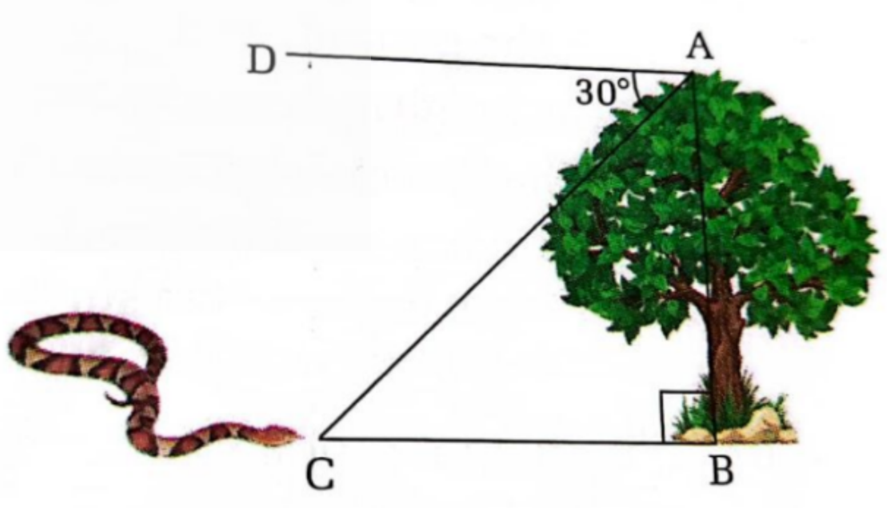
In the given figure:
AB = height of a tree
A = position of an eagle
C = position of a snake
BC = distance between the snake and the tree
∠DAC = angle made by the line of sight with horizontal ground when the eagle looks down the snake
What is ∠DAC called?
What is the measure of ∠ACB?
A circular pond has a pole standing vertically at its center. The top of the pole is 30 m above the water surface, and the angle of elevation of the top of the pole from a point on the circumference is (given). Find the radius of the pond.
From the top of a building 20 m high, a 1.7 m tall man observes the elevation of the top of a tower and finds it (given). If the distance between the building and the tower is 50 m, find the height of the tower.
Two men are on the opposite sides of a tower 40 m high on the same horizontal line. They observed the angles of elevation of the top of the tower and found them to be (given) and (given). Find the distance between them.
It seems there is something wrong with your internet connection. Please connect to the internet and start browsing again.
AdBlock Detected!
We have detected that you are using adblocking plugin in your browser. The revenue we earn by the advertisements is used to manage this website, we request you to whitelist our website in your adblocking plugin.
Site is Blocked
Sorry! This site is not available in your country.